
How to choose the right observability platform? Tips from the observability service provider
It’s not a single server to monitor anymore. Right now, companies have complex, distributed architectures spanning cloud platforms, microservices, databases, and applications.
Managing this complexity internally requires expertise, resources, and ongoing investment in observability tools and platforms. Organizations have more data volumes, growing customer expectations, and the need for real-time visibility across their technology stack.
Splunk’s 2025 survey of 1,855 professionals shows a clear change: observability has evolved from being reactive into a proactive engine for innovation and growth.
Choosing the right observability stack requires evaluating technical capabilities, scalability, integration complexity, and long-term support needs. The ideal provider should offer comprehensive monitoring of metrics, logs, and traces, enterprise-grade security, and 24/7 support, as well as extensive connectivity options for data sources.
What exactly is an observability platform, and why do you need one?
An observability tool gives comprehensive monitoring and visibility that tracks the health, performance, and behavior of your entire digital infrastructure. Unlike traditional monitoring that simply alerts you when something breaks, observability providers offer deep insights and allow a proactive approach.
Infrastructure observability has become essential as organizations face increased data volumes, growing customer expectations, and the need for real-time visibility across their technology stack. When part of the system fails, companies want to fix it before the downtime affects customers.
Key Pain Points in Modern IT Operations
- Alert fatigue – important issues go unnoticed due to too many alerts and bad filtering.
- Teams spend more time than they should responding to alerts
- Logs scattered across services with no unified view. Teams rely on scattered visibility
- It takes a long time to debug a production issue and see what’s actually happening inside the system
- No preventing, only firefighting
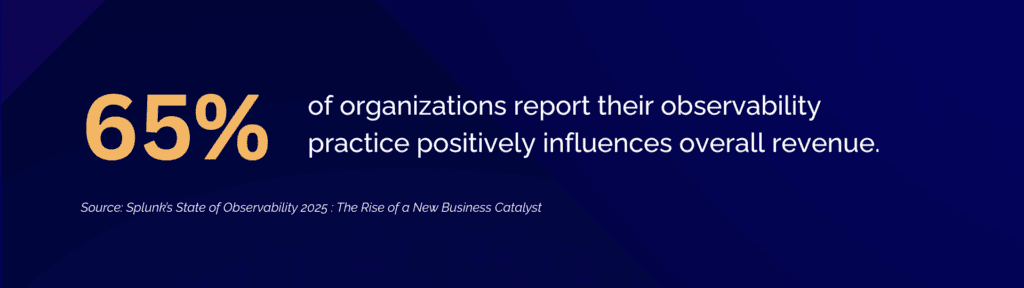
The evolution from reactive monitoring to proactive observability represents a fundamental shift in how organizations approach system resilience. With a comprehensive system, observability teams can identify performance degradation and potential problems before they impact users or business operations, rather than putting out fires.
If you want to check your current observability level, check out our free observability assessment, prepared by experts here.
What key features should you look for in an observability platform?
The most important features of an observability platform cover multiple aspects like integration sources, alerting, and analyzed data. These key parts provide the foundation for effective monitoring across different applications, infrastructure, and user experiences.
Metrics collection
Collected metrics should cover infrastructure performance indicators like CPU usage, memory consumption, and network throughput, alongside application-specific metrics such as response times, error rates, and transaction volumes. The platform should automatically discover and monitor new services as your environment scales.
Distributed tracing capabilities
This is a crucial part for understanding request flows through complex, microservices-based architectures. Tracing capabilities help identify bottlenecks, failed dependencies, and performance issues across service boundaries that traditional monitoring approaches often miss.
Log aggregation and analysis
Log aggregation should provide deep search, filtering, and correlation capabilities. The large data volumes are the worst enemy here – we don’t want the system to crash under the bigger traffic. Leading platforms like Splunk Observability Cloud combine these capabilities with advanced analytics and machine learning for anomaly detection and predictive insights.
Integration capabilities
Without proper integrations, there’s no data, and no insights. Determine how effectively the observability platform connects with your existing tools, cloud platforms, and deployment pipelines. Not every provider will be able to connect their platform to, for example, unstructured data. Look for providers offering prebuilt connectors for major cloud services, container orchestration platforms, and popular development tools to minimize implementation complexity.
Open standards and open-source ingestion
Look for an observability platform that supports open, open-source ingestion standards like OpenTelemetry. These standards help teams collect data in a consistent way across different systems and tools. They reduce integration complexity and make it easier to add new services over time. Open ingestion frameworks also allow data collection pipelines to scale and evolve independently from the observability platform itself, giving teams more flexibility in the long run.

Source: www.splunk.com/en_us/resources/videos/logs-and-metrics-and-traces-oh-my.html
How do you evaluate observability platforms for your specific needs?
Begin your evaluation by conducting a thorough technical requirements assessment covering your current infrastructure, anticipated growth, data retention needs, compliance requirements, and integration complexity. This foundation guarantees that you will select a provider who can support both your immediate needs and your future expansion, without requiring you to migrate to a different platform.
Scalability
While considering a new observability platform, you should address data volume growth, user expansion and geographic distribution requirements. Evaluate how providers handle spikes in data ingestion, scaling of storage, and query performance as your monitoring footprint expands. Also consider whether the platform can accommodate seasonal traffic variations and rapid business growth.
Data retention policies
Data retention policies directly impact both functionality and costs. Assess how long you need detailed metrics, logs, and traces available for analysis, troubleshooting, and compliance purposes. Different data types may require varying retention periods, so ensure the provider offers flexible policies that align with your operational and regulatory requirements.
Costs
Your analysis should include not only licensing and subscription fees but also implementation costs, training requirements, and ongoing operational expenses. Observability as a Service (OaaS) models often provide more predictable costs compared to self-managed solutions, particularly when factoring in the expertise required for platform management and maintenance.
Compliance
Compliance requirements vary significantly across industries and geographic regions. Verify that potential providers meet relevant standards such as SOC 2, ISO 27001, GDPR, or industry-specific regulations. Consider data residency requirements and the provider’s ability to support audit processes.
Expert knowledge
On the one hand, consider aspects such as the expertise needed to implement a new tool, and on the other, its maintenance.
Professional observability providers offer enterprise-grade solutions built around proven platforms. This eliminates the need for internal teams to manage complex monitoring infrastructure, while ensuring comprehensive coverage of all system components.
Consider providers offering Observability as a Service (OaaS) for total transparency, freeing you from the operational overheads of managing observability infrastructure in-house.
What are the most common mistakes when choosing an observability provider?
Many companies rely on distributed systems that do not help collect data in one place, but only burden the cybersecurity team, which is usually already facing staff shortages.
The most frequent mistake involves overengineering solutions by selecting platforms with excessive complexity or capabilities that exceed actual requirements. This approach leads to unnecessary costs, extended implementation timelines, and operational overhead that provides little business value.
Teams want more than basic infrastructure and application metrics. It is not enough to know that an API is slow or a server is running out of space. Teams want to understand how technical issues affect the business. They want to know how outages impact customers and operations. They want to see how website slowdowns affect sales and conversions. And understand which user groups are the most valuable and whether those users are having a good experience.
Ignoring future scalability is another critical error that can lead to costly platform migrations as organisations grow. Many teams focus solely on their current requirements, failing to consider how their monitoring needs will evolve as they add services, expand geographically or increase their data volumes.
Focusing exclusively on price while neglecting the total cost of ownership creates false economies. The cheapest solution often requires significant internal expertise, custom development, and ongoing maintenance that ultimately exceeds the cost of comprehensive managed services.
As mentioned above, another very important factor is the data that can be connected to our platform. Many teams end up with a variety of unconnected tools just for this reason. Teams often assume observability platforms will easily connect with existing tools and workflows without considering the effort required for proper integration, data correlation, and workflow adaptation. Not every tool supports all types of data.
It is also worth noting that a lack of training prevents teams from effectively leveraging the platform’s capabilities, leading to poorer adoption. Successful implementations require adequate training for both technical teams and stakeholders who rely on observability insights to make decisions.
Summary
The best approach is to work with experienced providers who understand these common problems and can help you choose and use the right solution. We help organisations avoid these mistakes by providing a full review, planning how to implement the changes, and ongoing support. This makes sure that initiatives to make processes more visible deliver real business benefits right from the start.
Contact us to start your observability journey with professionals and packages that fit your needs.
Facebook
Twitter
LinkedIn