How to Optimize Data Management with Observability
The amount of data is growing every day – including in businesses. When the term data science was first coined in the 1960s, no one could have predicted the amount of data in the digital age. Today, we are talking about continuous data, not just discrete data. The constant need to monitor the health of devices, systems and networks.
Organizations are managing increasingly complex environments, like data lakes, warehouses, cloud platforms, and on-premise servers. The challenge? Keeping these systems optimized, secure, and efficient without drowning in an ocean of data.
If you feel that this is your reality, observability can be your greatest ally.
What is observability and why do you need it?
Observability is more than just monitoring—it’s about understanding your systems in real time by analyzing logs, metrics, and traces. It answers three critical questions:
- What is happening? – Real-time system monitoring to track performance and detect anomalies.
- Why is it happening? – Root cause analysis to identify and fix bottlenecks.
- What will happen next? – Predictive insights to prevent failures before they occur.
With a comprehensive observability strategy, growing companies can shift from a reactive approach to a proactive one, ensuring optimized performance, security, and compliance across all data environments.
Monitoring
- Alerts when something fails
- Shows predefined metrics
- Tells you that there’s a problem
Observability
- Shows what’s happening across the whole system
- Connects data from multiple sources
- Helps you understand why it happened
What are the various data storages?
- A Data Lake stores large amounts of raw, unstructured, and semi-structured data, ideal for big data analytics. Observability helps analyze telemetry data like logs and metrics for monitoring system health.
- A Data Warehouse focuses on structured data that’s cleaned and ready for analysis, commonly used for business intelligence. Observability tracks query performance and resource utilization for real-time insights.
- A Data Lakehouse combines features of both data lakes and warehouses, allowing raw data storage while ensuring transactional consistency and structured querying. Observability monitors data ingestion and querying across diverse data structures.
- Cloud Environments provide scalable storage and computing resources, enabling efficient scaling without physical infrastructure. Observability tracks resource usage and detects anomalies in real time.
- On-prem servers are preferred for security and compliance, and despite cloud growth, they remain widely used. Observability monitors hardware performance and network traffic to ensure stability.
By integrating observability across these data management solutions, organizations can enhance performance, detect anomalies early, and ensure seamless operations across diverse storage environments.
Data security and compliance are significant challenges in data management. This involves maintaining the security of data while ensuring adherence to regulatory requirements. Observability tools help by tracking who accessed data, when, and how. This functionality enables businesses to meet audit requirements and respond to security threats in real-time.
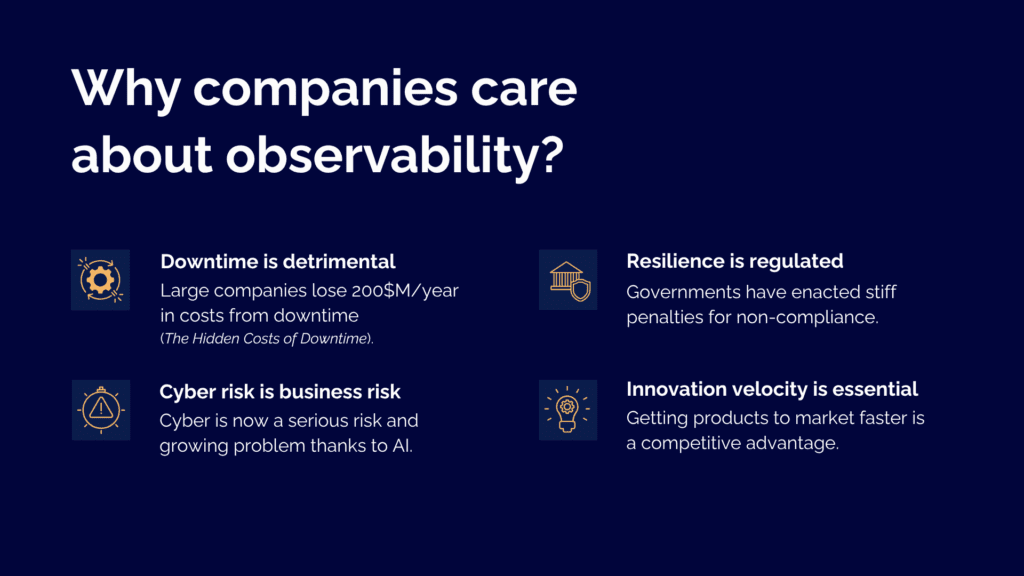
Why more and more companies care about observability?
- Downtime is detrimental – Large companies lose 200$M/year in costs from downtime (The Hidden Costs of Downtime).
- Cyber risk is business risk – Cyber is now serious risk and growing problem thanks to AI.
- Resilience is regulated – Governments have enacted stiff penalties for non-compliance.
- Innovation velocity is essential – Getting products to market faster is a competitive advantage.
Why Choose WeAre for Observability?
At WeAre, we specialize in providing Observability as a Service (OaaS) that seamlessly integrates with your existing data infrastructure. Here’s why businesses trust us:
- 24/7 Expert Support: Our certified Splunk specialists ensure your systems run smoothly—always.
- Scalable Solutions: Whether you manage terabytes or petabytes of data, we help you scale without complexity.
- Actionable Insights: We don’t just provide data; we deliver real-time insights that drive business decisions.
- Seamless Integration: Our observability solutions work across cloud, hybrid, and on-prem environments with zero disruptions.
- Cost Efficiency: Proactive monitoring reduces downtime, optimizes resource allocation, and saves costs in the long run.
Free Observability
Assessment and Consultation
30-minute expert consultation
Custom improvement roadmap
Detailed assessment report
Facebook
Twitter
LinkedIn