
SLA Monitoring in a Regulated Industry | Case Study
Key takeaways:
- The customer needed a reliable way to prove that their log management and archiving service meets strict security, compliance, and audit requirements over time.
- WeAre introduced structured SLA monitoring through our Service Center operating model, built on Splunk expertise, with clear response practices and disciplined operational follow-up inside the customer’s environment.
- The result was a stable service with measurable performance, predictable ticket handling, and stronger operational visibility as new data sources and requirements evolved.
Overview
A leading financial organisation required a reliable method of collecting, storing and archiving large volumes of log data over long periods of time. Security and compliance requirements were strict, and access had to be controlled and auditable. Once the system had been implemented, it was necessary to ensure that it operated at an appropriate level and was monitored in accordance with the SLA.
WeAre supported the service through a structured Service Center operating model that brought clear SLA targets, disciplined ticket handling, and continuous operational follow-up inside the customer’s own environment. The outcome was a stable service that kept service levels on track, supported ongoing onboarding of new data sources, and improved operational visibility as requirements evolved.
The challenge
In financial services, log data supports audits, investigations, and regulatory requirements. It must remain protected, traceable, and available for authorized use for years.
In this case, the customer needed a solution that could collect log data from many systems, keep it securely retained for up to several years, and support controlled retrieval when required by authorized parties. In some situations, this also included responding to external requests related to specific individuals or transactions.
In one of our recent articles, we described how we implemented this log management solution. The next step was to implement an SLA monitoring system.
Why SLA monitoring mattered here
In regulated environments, SLA monitoring is how service performance becomes provable. It provides a clear, objective way to demonstrate that the service is meeting the agreed-upon standards.
The customer gets a documented baseline that supports internal accountability and external requirements. The service provider gets a clear way to demonstrate that commitments are being met and that response practices are reliable. When priorities shift or requirements grow, the discussion remains practical and fact-based because it is anchored in measured service levels rather than assumptions.
Project goal
The goal was to ensure the customer had an immutable, long-term storage of audit events that could scale as data volumes grew and remain operationally reliable as new sources and requirements were added.
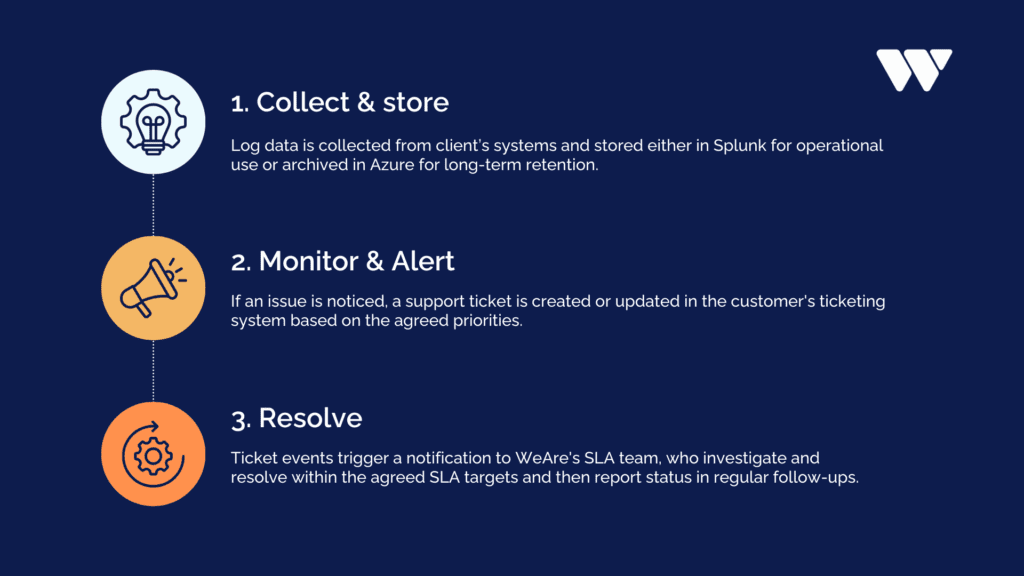
The service centered on collecting log data from multiple source systems and storing it in a way that supports long retention periods. Operationally valuable data is in Splunk, while other structured data is stored in Azure file services. This archived data was available for restoration as needed.
In practice, this meant keeping the ingestion and archiving pipeline stable, ensuring predictable response and resolution for tickets, supporting controlled restoration of archived data when needed, and improving the service continuously so troubleshooting became easier and operational risk stayed low.
In order to accurately assess the system’s performance, we needed to introduce SLA monitoring.
Our solution
We built the support model around ticket-based SLAs and clear response expectations. The service operated on agreed business-hour support, aligned to the nature of the service and the customer’s operating model. At the same time, the service design ensured that data handling remained resilient. A queue-based mechanism supported recovery if data transfers failed, so the focus stayed on correctness, completeness, and controlled recovery rather than rushing changes that could increase risk in a regulated system.
Because the environment was controlled and information sharing was limited by design, we ensured fast reaction without relying on constant access to the customer’s ticketing system. Ticket events were integrated into our internal tools, so the team is notified immediately when tickets are created or updated. This gives the customer predictable response behavior and ensures we can act within SLA timelines without breaking the rules of the environment.
SLA model and success criteria
Our responsibility is to respond to incoming tickets in time. Service success is measured through agreed response and resolution expectations by ticket priority. Response targets are defined for all priorities, and resolution targets are defined for the highest priorities. This gives the customer a consistent model for handling incidents and service requests and gives the joint team a shared language for urgency, escalation, and follow-up.
Tickets are handled consistently, priorities are clear, and follow-up is structured. Performance has been consistently high, with the team always fulfilling the SLA targets for critical tickets, and the customer satisfied with the service level. SLA performance and operational status are reviewed regularly with the service owner, and development priorities and operational improvements are handled with the wider working team.
Project results
The service ran reliably in a demanding finance environment, with fewer than ten incidents across the full service period. When issues did appear, the team handled them through fast investigation and structured root-cause analysis. Examples included oversized data dumps from a source system that stressed ingestion limits, and a test environment load increase after new integrations that required resource adjustments. In both cases, scope was confirmed, production impact was assessed, and corrective actions were implemented in a controlled way within the agreed SLA model.
SLA performance stayed consistently strong throughout the period discussed. The service met its SLA targets without breaches, which gave the customer a clear and measurable basis for accountability and gave the joint team a proven operating model that worked under real constraints.
We also have plans for the next steps of the project. End-to-end availability measurement was identified as another area to strengthen. The team began building the monitoring coverage needed to support more complete availability tracking moving forward.
Observability Hub Service Center
At WeAre, the Observability Hub Service Center package brings this discipline into practice. It provides reliable managed monitoring, alert follow-up, and SLA tracking for organisations in various industries, particularly those that rely on mission-critical systems and require guaranteed operational continuity.
If you want greater confidence in your SLA compliance and operational resilience, explore how our Service Center package can support your environment.
Facebook
Twitter
LinkedIn