What is People Counting and Occupancy Analytics | VisitorSense
What Is a People Counting System?
A people counting system is an automated solution that measures how many individuals enter, exit, or move through a physical space over time. It provides real-time occupancy data and visitor analytics that help organizations replace guesswork with insights.
Combining people counting with occupancy analytics gives businesses visibility of peak hours, traffic patterns, dwell times and customer flow. This data can be used to make smarter staffing decisions, improve store layouts, optimise space utilisation and plan resources more effectively. Rather than relying on assumptions, organisations can align their operations with actual visitor behaviour.
How People Counting Evolved?
Not long ago, most businesses had only two ways to understand visitor traffic: guesswork or manual counting. In retail, shopping centres, offices, and public spaces, people counting often meant a staff member using a clicker at the door, or reviewing security camera footage afterward. It looked simple, but the data was rarely reliable enough for real decision-making.
But manual counting has a lot of downfalls. People walk in groups, enter and exit at the same time, pause near the entrance, or move unpredictably. Over a full day, accuracy drops because employees get distracted, tired, or pulled into other tasks. This leads to inconsistent footfall data, which then affects staffing plans, conversion rate calculations, and even basic reporting.
People Counting with CCTV
The next step for many organizations was to use CCTV for footfall analytics. Theoretically, it sounds good – the cameras are already in place, and we don’t have to buy anything new. But CCTV is built for security, not precise people counting. The camera angle is usually meant to capture faces and incidents, not clean entrance crossings. Lighting, shadows, busy doors, and crowd density also reduce accuracy. On top of that, CCTV-based tracking can raise privacy concerns under GDPR, especially when cameras capture identifiable video.
Today, businesses are moving toward dedicated people counting sensors and AI-based footfall analytics because they are designed for one purpose: accurate, privacy-safe counting and customer flow insights. Instead of guessing visitor traffic, teams can track real footfall trends, peak hours, occupancy, dwell time, and movement patterns, and then connect that data to sales and operations.
People Counting System - 6 Smart Solutions Compared
Modern people counting has evolved far beyond simple cameras and basic motion detection. Today’s systems combine edge computing, cloud analytics, APIs, and observability platforms to turn physical movement into structured, actionable data.
Smart Cameras
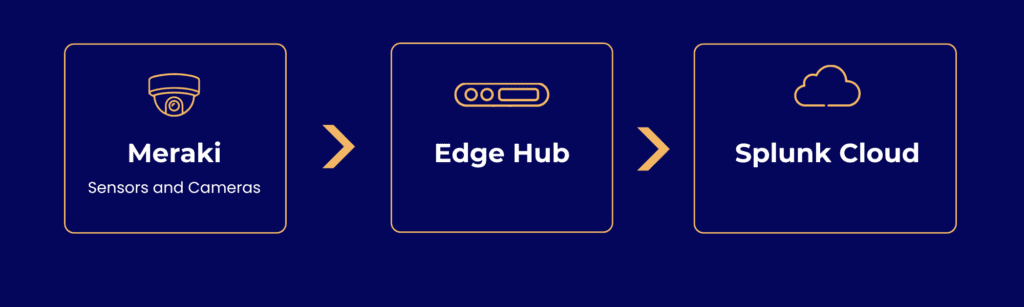
Unlike traditional CCTV systems that simply record footage, modern smart cameras, such as Cisco Meraki MV cameras, process data directly on the device itself. This approach, known as edge computing, allows the camera to detect and classify objects in real time.
Instead of just capturing video, the camera identifies whether the moving object is a person or something else, tracks movement direction, and interprets activity within defined zones. Because the processing happens on the device, there is no need for heavy on-site servers or complex video infrastructure.
For people counting use cases, fisheye models like the MV33 and MV93 are especially effective. When ceiling-mounted and configured correctly, they provide a wide field of view with minimal occlusion, making them highly suitable for entrance monitoring and occupancy tracking.
Cloud-Managed Analytics
Cloud-managed analytics allow people-counting data to scale from one location to hundreds. Instead of streaming continuous video, the system transmits anonymized metadata to the cloud. This reduces bandwidth usage, improves privacy, and still delivers measurable insights such as total entries and exits, peak occupancy, directional movement, and historical footfall trends.
Through a centralized dashboard, managers can monitor a single store or multiple sites across regions from one interface. This is where the solution moves beyond security monitoring and becomes a true business intelligence tool.
Heatmaps and Flow Tracking
Numbers show how many visitors entered. Heatmaps show where they moved. Motion heatmaps visualize activity intensity within a space. Over time, they reveal bottlenecks, underutilized areas, popular displays, and queue build-up patterns. This supports store layout optimization, space planning, and safety compliance.
Dwell Time and Zone-Based Intelligence
Modern systems allow you to define specific areas of interest, such as a checkout line, promotional display area, reception desk, or waiting area. Within these zones, the system can measure dwell time: how long individuals remain in that space.
This insight answers critical operational questions:
- Are customers engaging with a campaign display?
- Is a queue building up beyond acceptable wait times?
- Are certain departments consistently underperforming in engagement?

Open APIs and Real-Time Automation
Cisco Meraki MV supports REST and MQTT APIs, allowing footfall and occupancy data to integrate with BI tools, CRM platforms, facility systems, and custom dashboards.
Alerts can be automated. For example, if occupancy exceeds a defined threshold, a notification can be sent instantly. This shifts people counting from passive reporting to real-time operational response
All these capabilities are powerful on their own, but what if they were delivered as one structured, ready-to-use service?
Our Solution as a Service: VisitorSense
VisitorSense is our packaged visitor analytics solution built to deliver reliable data, clear reporting, and actionable insight. It combines smart cameras, cloud analytics, and automated reporting into one structured service that organizations can actually use.
VisitorSense transforms movement inside a physical space into structured, usable data. Instead of only showing how many people entered a building, it helps organizations understand how spaces are used throughout the day, where visitors concentrate, how long they stay in certain areas, and when abnormal patterns occur. This enables earlier reactions to crowding, better staffing decisions, and measurable evaluation of layouts, services, and campaigns.
Instead of viewing visitor counts in isolation, VisitorSense connects footfall with:
- Visitor flow tracking
- Heatmaps for activity visualization
- Dwell time measurement in defined zones
- Automated reporting for stakeholders
- Smart alerts for unusual activity or threshold breaches
All analytics are delivered in a privacy-first manner. VisitorSense focuses on anonymized movement data rather than personal identity, ensuring compliance with data protection standards while still providing meaningful operational visibility.
The Business Case: How VisitorSense Improves Profitability
VisitorSense is our people-counting and visitor analytics service built on Cisco Meraki smart camera technology. It captures footfall data, analyzes movement patterns, and turns physical space usage into measurable business insight.
A people counting system works in a simple way. Smart cameras installed at entrances and key zones detect movement. The system counts entries and exits, measures dwell time, and visualizes traffic through heatmaps. The data is processed securely and presented in a clear dashboard with automated reporting and alerts.
Instead of guessing how a space performs, organizations can see it in numbers.
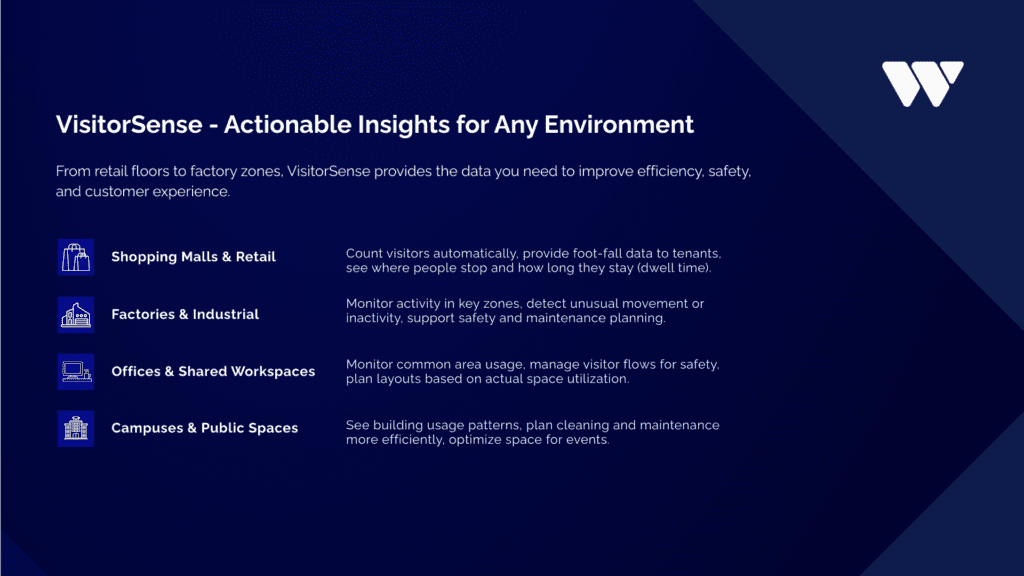
1. Retail - Increase Conversion and Optimize Operations
In retail environments, VisitorSense connects footfall data with store performance.
You can measure:
- How many people enter the store
- When peak hours occur
- Which zones attract the most attention
- How long customers stay in specific areas
This makes it possible to optimize staffing during busy hours and reduce overstaffing during slow periods. Store layouts can be adjusted based on real traffic flow. Promotions can be evaluated against actual visitor numbers. Conversion rate becomes measurable because you know how many visitors entered versus how many purchases were made.
2. Offices and Smart Buildings - Improve Space Utilization
In office environments, VisitorSense helps organizations understand how spaces are used throughout the day.
It provides insight into:
- Occupancy levels in shared areas
- Meeting room usage
- Lobby and reception traffic
- Peak times during the day
This supports better space planning and reduces unused workspace. Cleaning schedules and facility services can be adjusted based on real usage. Energy efficiency improves when occupancy data is aligned with building systems.
3. Public Sector - Support Safety and Resource Planning
In public buildings, campuses, and service centers, people counting supports safer and more efficient operations. VisitorSense helps organizations:
- Monitor crowd levels in real time
- Prevent overcrowding
- Plan maintenance based on actual usage
- Allocate staff where demand is highest
Data Governance & Privacy
In the Nordics and in the EU, where GDPR and privacy expectations are among the strictest globally, VisitorSense is built on a clear Privacy by Design principle. Using Cisco Meraki smart cameras, the system processes data directly on the device and converts movement into anonymous metadata such as coordinates and motion patterns. No facial recognition is used, no biometric data is created, and individuals are never identified. The solution measures presence and flow, not identity.
All data is encrypted in transit and at rest, and enterprise-grade access controls ensure that only authorized users can view dashboards or manage devices. Video recording can be disabled, allowing the camera to function purely as a secure data sensor. This means organizations gain reliable people counting, occupancy monitoring, and visitor analytics while remaining fully aligned with GDPR and Nordic data governance standards.
Conclusion
VisitorSense, as part of the WeAre Observability Hub, is designed to make physical spaces measurable. It helps organizations track visitor flow, identify peak times, visualize active zones through heatmaps, monitor occupancy levels, and understand how spaces are truly used. Built on Cisco Meraki smart camera technology and engineered with privacy by design, it delivers reliable people counting and visitor analytics without compromising GDPR compliance or individual anonymity.
Retailers can improve conversion rates and staffing efficiency. Offices can optimize space utilization and reduce operational waste. Public sector organizations can enhance safety and plan resources based on real data. All through one structured, managed service.
If you want to understand how your physical spaces perform today, and how they could perform better, request a free VisitorSense assessment via our contact form. Let’s turn your visitor data into actionable insight.
Monitoring infrastructure, applications, business impact, and early warning indicators in parallel requires more than technical tools. It demands clear ownership, structured escalation processes, and continuous operational follow-up. In many organizations, especially in hybrid environments, this level of oversight becomes difficult to sustain internally.
This is where a structured Service Center approach becomes valuable. Instead of treating SLA monitoring as a collection of disconnected alerts, it establishes a managed layer that ensures performance is continuously observed, thresholds are actively followed up on, and service levels remain aligned with business expectations.