What Is SLA Monitoring and Why It Matters for Modern IT Operations?
Introduction
As IT has become a core part of business operations, many organizations rely on external service providers to manage systems, infrastructure, and applications. These outsourcing relationships are not only technical agreements, but they are also long-term partnerships that require trust, clear responsibilities, and structured governance.
When expectations are unclear or poorly managed, the result can be higher costs, operational disruption, and strained relationships between the customer and the provider. To prevent this, companies use formal agreements such as Service Level Agreements (SLAs) to define measurable expectations around performance, availability, and response times.
However, simply defining an SLA is not enough. The real challenge lies in ensuring that those agreed service levels are continuously monitored, managed, and improved over time.
In this blog, we will explore what SLA monitoring means in practice, why it matters for modern IT environments, how SLA breaches can be prevented, and how structured monitoring and operational oversight strengthen SLA compliance. We will also look at how a managed Service Center approach supports organizations in maintaining reliable and accountable service performance.
What is an SLA?
A Service Level Agreement (SLA) is a formal contract between a service provider and a customer that clearly defines what services will be delivered and what level of performance is expected. It typically outlines measurable targets such as uptime, response time, availability, and support commitments.
Just as importantly, an SLA explains how performance will be monitored, how results are reported, and what happens if agreed service levels are not met. In this way, an SLA sets customer expectations, holds providers accountable, and creates transparency around service quality.
Beyond performance metrics, a well-structured SLA also establishes governance principles for the relationship. It defines communication channels, reporting practices, escalation paths, and rules for managing change when business or technical requirements evolve. Because SLAs are often drafted by business or legal teams, close collaboration with technical experts is essential to ensure that service definitions are realistic and measurable. When developed jointly and managed properly, SLAs provide a stable foundation for long-term cooperation, reduce uncertainty, and support effective SLA monitoring throughout the lifecycle of the service.
While defining service levels is important, not all SLAs are equally effective. A well-designed SLA includes a clear structure and governance to ensure it works in practice.
What Makes an SLA Effective?
1. Clear Service Scope
Services must be precisely defined. Ambiguity leads to disputes and unmet expectations.
The SLA should clearly state what is included, what is excluded, and where the boundaries apply. If infrastructure support is provided, it must specify the exact activities covered, the environments in scope, and any limitations. Exclusions, such as application code changes, must be explicitly documented. A clear scope definition protects both parties and eliminates interpretation risk.
2. Measurable Performance Targets
Uptime, response times, and availability must be realistic and clearly measurable.
Performance commitments should always be defined numerically. Availability percentages, incident response times, resolution targets, service desk performance, and backup reliability must be expressed in measurable terms. Well-defined metrics create accountability and allow objective performance evaluation.
3. Defined Measurement Methodology
Both parties must agree on how performance is calculated and reported.
The SLA should specify the monitoring tools used, the calculation logic behind metrics, and any exclusions such as planned maintenance. Downtime definitions must be clear and consistently applied. Agreement on methodology prevents future disagreements about performance results.
4. Transparent Governance Model
Clear reporting cycles, escalation paths, and communication structures are essential.
The agreement must define reporting frequency, escalation hierarchy, responsible roles on both sides, and communication channels during incidents. Governance ensures structured oversight and continuous alignment between provider and customer.
5. Accountability and Consequences
The agreement must define what happens if service levels are not met.
Service credits, remediation requirements, and termination rights in cases of repeated failure should be clearly documented. Accountability mechanisms reinforce commitment and maintain service quality standards.
6. Change Management Process
Modern IT environments evolve. SLAs must include a structured way to manage change.
Major architectural or operational changes should require an impact assessment, and SLA metrics should be reviewed periodically to remain aligned with business needs. A well-designed SLA is not static; it adapts as the environment evolves.
Why SLA Monitoring Is Necessary?
As organizations move critical systems to cloud and hybrid environments, operational responsibility becomes shared between the business and the service provider. While cloud services bring scalability and cost efficiency, they also reduce direct visibility into how systems are performing in real time. Businesses rely on providers to deliver according to agreed standards, but they no longer control every technical layer themselves.
Service Level Agreements define expected availability, performance targets, and response times. However, an SLA is ultimately a contractual document. It outlines what should happen, but it does not actively ensure that performance remains stable under changing conditions.
In real-world environments, service degradation often happens gradually. Response times increase slightly. Integrations slow down under higher load. Infrastructure resources approach capacity limits. These early warning signs may not immediately breach SLA thresholds, yet they can already affect user experience and business operations.
If SLA performance is not continuously monitored, organizations may only become aware of issues after customers report them or after measurable damage has occurred. At that point, even if contractual penalties apply, the financial loss and reputational impact cannot be undone.
Continuous SLA monitoring provides visibility across systems, validates that agreed service levels are consistently met, and enables early intervention before minor performance issues escalate into major incidents. It transforms the SLA from a static agreement into an actively managed operational commitment.
What Should Be Monitored to Protect an SLA?
In on-prem and hybrid cloud environments, SLA compliance depends on visibility across multiple technical and operational layers. Monitoring only one component is not enough. To truly protect an SLA, organizations must observe infrastructure, applications, and business-level performance together.
Infrastructure Stability
At the foundation, infrastructure must remain consistently available and resilient. This includes servers, virtual machines, networks, databases, and storage systems. Any instability at this level can silently affect performance and eventually compromise agreed service levels.
Application and Integration Performance
Even with stable infrastructure, applications and system integrations can introduce delays, errors, or failures. Monitoring response times, API health, transaction flows, and deployment stability ensures that services function as expected across hybrid environments.
Business-Level Service Performance
Technical health does not always reflect user experience. Monitoring must also focus on end-to-end transactions, response times during peak usage, and the impact on critical business processes to ensure the service truly delivers value.
Early Warning Indicators and Escalation
Effective SLA monitoring is proactive. It involves identifying performance trends, detecting abnormal behavior, and triggering structured escalation before thresholds are breached. Early intervention prevents minor degradation from turning into contractual violations.
| Monitoring Category | Focus Areas & Metrics | Impact on SLAs |
|---|---|---|
| 1. Infrastructure Stability |
| Performance bottlenecks in hybrid environments (on-prem vs. cloud) can stay hidden and degrade service levels if not continuously monitored. |
| 2. Application & Integration |
| In hybrid architectures, integration points between cloud and on-prem systems are common failure points where SLA violations often originate. |
| 3. Business-Level Service |
| Ensures service performance aligns with actual business expectations, as user experience can degrade even if technical limits are met. |
| 4. Thresholds & Early Warning |
| Acts as a proactive layer to identify trends and technical issues before they cross thresholds and become actual SLA violations. |
Monitoring infrastructure, applications, business impact, and early warning indicators in parallel requires more than technical tools. It demands clear ownership, structured escalation processes, and continuous operational follow-up. In many organizations, especially in hybrid environments, this level of oversight becomes difficult to sustain internally.
This is where a structured Service Center approach becomes valuable. Instead of treating SLA monitoring as a collection of disconnected alerts, it establishes a managed layer that ensures performance is continuously observed, thresholds are actively followed up on, and service levels remain aligned with business expectations.
What is the WeAre Service Center Package?
As discussed earlier, defining an SLA and implementing monitoring tools is only part of service reliability. The real challenge lies in alerts being seen, followed up, escalated when necessary, and translated into meaningful operational action.
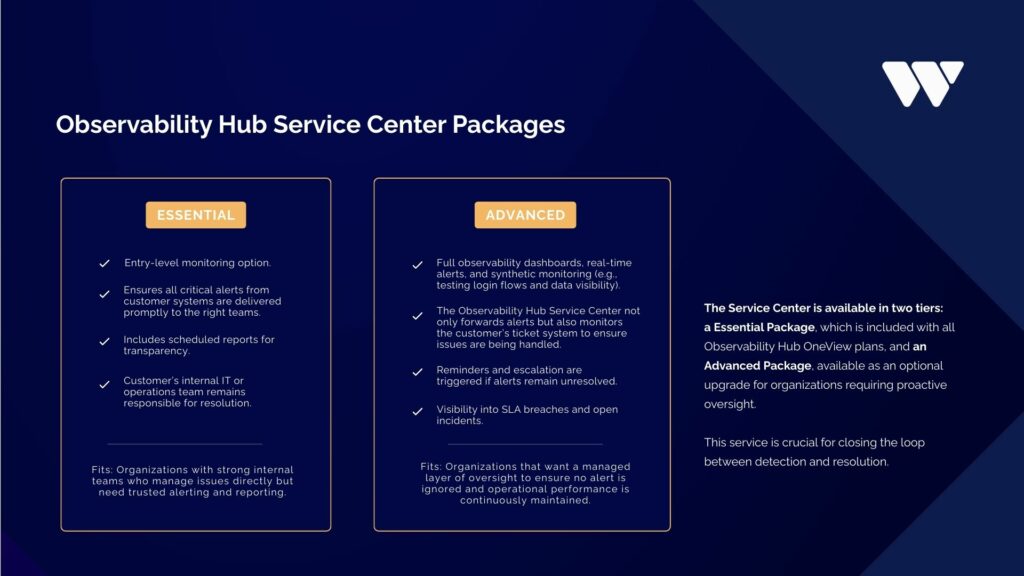
The WeAre Observability Hub – Service Centre is one of our service packages, ensuring that every critical alert is brought to the attention of the right team. It strengthens SLA monitoring, improves alert management, and supports proactive operational response across hybrid and on-prem environments.
WeAre Service Center Features
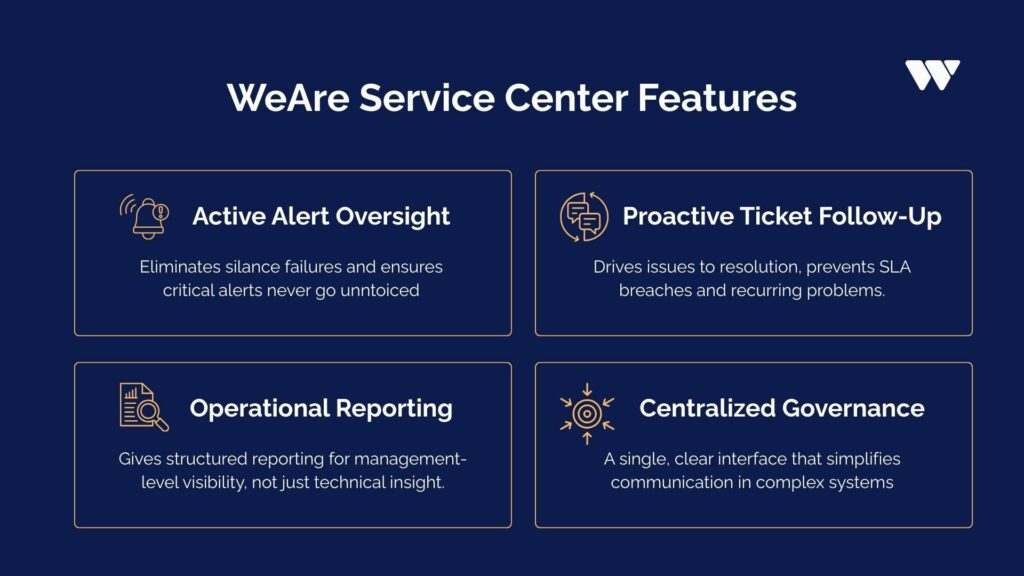
Alert Oversight: When an alert is triggered, it is actively monitored and reviewed. Critical alerts are not left unattended. If escalation is required, it is initiated. If alerts remain unresolved, visibility is created to ensure they are not forgotten. This reduces the risk of silent failures and unnoticed SLA breaches.
Ticket Follow-Up: The Service Center tracks whether alerts are progressing in your ticketing system. If issues remain unresolved for too long, follow-up is ensured. Recurring problems and potential SLA violations are highlighted. The focus is not just on sending alerts, but on ensuring they move toward resolution.
Operational Reporting: You receive structured reporting on alert volumes, resolution times, recurring patterns, and overall system health. This provides management-level visibility, not just technical insight. It helps organizations identify trends, optimize processes, and maintain operational discipline.
Single Point of Contact: Instead of managing multiple dashboards and disconnected systems, the Service Center provides a structured and centralized operational interface. This creates clarity in communication and simplifies governance across complex environments.
Service Center Packages
The Service Center can be tailored according to operational needs.
Essential Service Center Package: Includes structured alert forwarding, basic oversight, and regular reporting. Suitable for organizations that want visibility and structured communication while retaining internal responsibility for resolution.
Advanced Service Center Package: Includes proactive alert follow-up, SLA monitoring, escalation management, and deeper operational oversight. Designed for organizations that require stronger governance and reduced internal operational burden.
Why Choose our Service Center Package?
Many organizations already have monitoring tools in place. However, monitoring alone does not guarantee operational maturity. Alerts can be ignored, teams can become overloaded, and ownership may be unclear. This is where downtime and SLA breaches often begin.
The Service Center bridges the gap between “an alert exists” and “the issue is handled.” It introduces proactive oversight, structured escalation, and operational accountability. Customers benefit from faster response times, reduced alert fatigue, improved SLA tracking, and greater confidence that someone is continuously overseeing the operational layer.
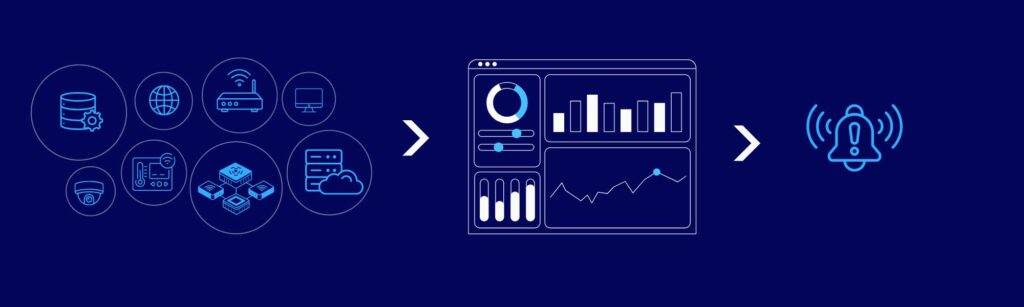
Traditional monitoring ensures that problems are identified. WeAre Service Center goes one step further – it forces active action and the search for solutions. This distinction is particularly important in hybrid environments where infrastructure and applications span multiple platforms and responsibilities.
Conclusion
An SLA defines expectations, but expectations alone do not guarantee reliability. In hybrid and multi-layer environments, service performance depends on infrastructure, applications, integrations, and external providers working together seamlessly. A slowdown in one layer can create symptoms in another. Without proper visibility, teams may misinterpret issues, escalate to the wrong provider, or detect violations too late.
This is why SLA monitoring must go beyond basic uptime tracking. It requires continuous validation, cross-layer visibility, and structured escalation processes that identify the true root cause of performance degradation. Effective SLA monitoring reduces false positives, prevents cascading failures, and protects both operational stability and business trust.
At WeAre, the Observability Hub, Service Center package brings this discipline into practice. By combining managed monitoring, alert follow-up, SLA tracking, and operational oversight, we help organizations ensure that service levels are not only defined in contracts but actively upheld in real time.
If you want greater confidence in your SLA compliance and operational resilience, explore how our Service Center package can support your environment.