

What is Splunk? Powerful Guide to Splunk Observability in 2026
Key takeaways
- Splunk helps businesses turn machine data into actionable insight across observability, security, and operations.
- Splunk Observability gives teams end-to-end visibility to detect issues faster and understand root causes more clearly.
- Splunk AI enhances observability with anomaly detection, predictive analytics, and smarter incident response.
- Splunk’s broader portfolio, including Splunk Platform and Splunk Enterprise Security, supports a more unified and resilient operating model.
- The real value of Splunk comes from using it strategically to improve performance, reliability, and business outcomes.
Introduction
Modern businesses operate in increasingly complex digital environments. Applications are distributed, infrastructure is constantly changing, and data flows across cloud, on-premise, and hybrid systems. In this reality, simply knowing that something is broken is no longer enough. Organizations need to understand why it happened, where it started, and how it affects the business.
This is where Splunk Observability becomes essential. Splunk goes beyond traditional monitoring by helping organizations turn data into meaningful action. It connects technical performance directly to business outcomes, enabling faster decisions, stronger reliability, and better customer experiences.
As systems continue to grow in complexity, the ability to see clearly across them is no longer optional. It is a competitive advantage.
What is Splunk?
Splunk is a powerful data platform designed to collect, analyze, and visualize data from applications, infrastructure, and systems. It enables organizations to monitor real-time events, troubleshoot issues, and gain insights that support better decision-making.
At its core, Splunk helps businesses turn data into doing.
The name “Splunk” comes from spelunking, the act of exploring caves. Just like explorers uncover hidden paths, Splunk helps teams navigate large volumes of data to find valuable insights.
What makes Splunk especially powerful is its flexibility. It can ingest data from almost any source, work across cloud and hybrid environments, and provide both real-time and historical insights. This makes it a strong foundation for modern observability and analytics.
Why Traditional Monitoring Falls Short
Traditional monitoring focuses on predefined alerts and known issues. While this worked in simpler environments, it struggles in modern architectures where systems are distributed, dependencies change constantly, and failures are often unpredictable.
Monitoring can tell you what happened, but not why it happened.
This gap becomes costly when teams spend hours investigating issues without clear answers, slowing down resolution and increasing business impact.
What is Observability?
Observability takes a broader approach. It allows teams to explore system behavior in depth, even when issues are unexpected. Instead of reacting to alerts, teams can analyze patterns, trace dependencies, and uncover root causes faster.
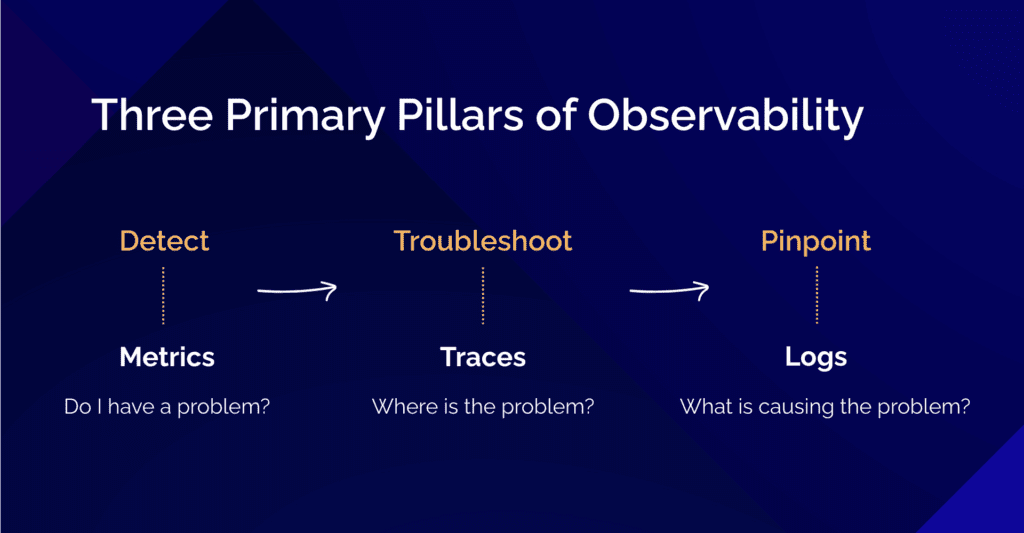
Observability is built on three core data types:
- Metrics – performance trends and system health
- Traces – request flows across services
- Logs – detailed event-level insights
Together, they help answer key questions about system performance, issue location, and root cause.
Splunk Product Portfolio: A Unified Approach
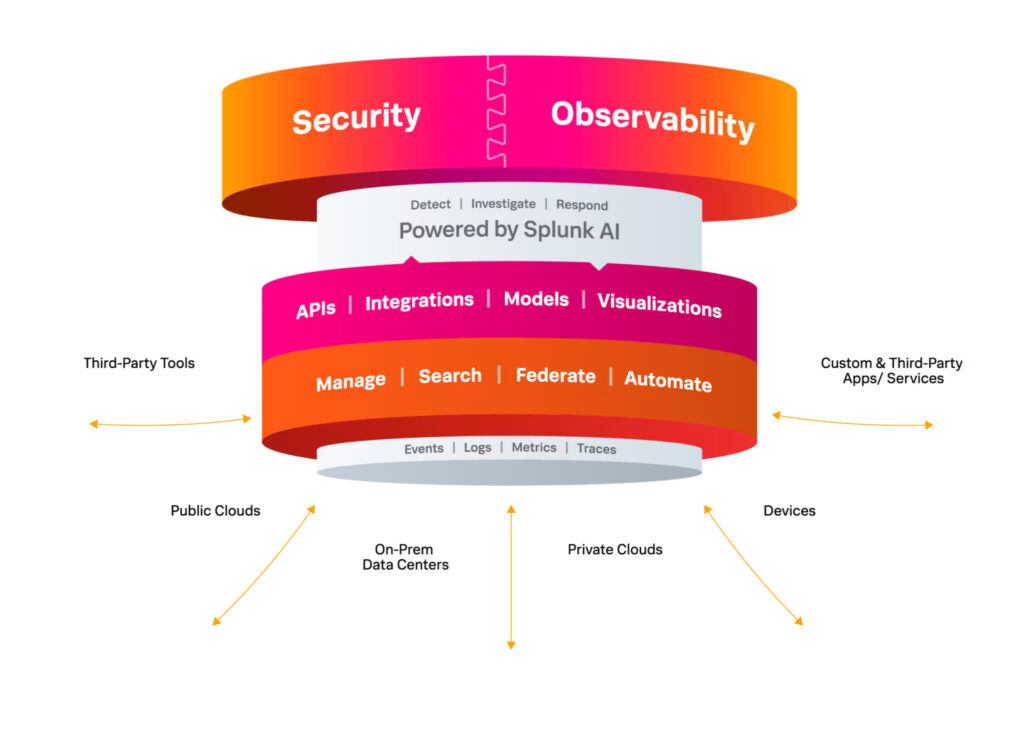
Splunk brings observability, security, and data analytics into one unified ecosystem. Instead of working with disconnected tools, organizations can manage everything from a single platform powered by real-time data and AI-driven insights.
The Splunk portfolio includes three core areas:
- Splunk Platform
- Splunk Observability
- Splunk Enterprise Security
Each plays a different role, but together they provide a complete view of digital operations.
In this blog, we focus primarily on Splunk Observability, while also touching on the broader ecosystem.
Splunk Observability: End-to-End Visibility Across Systems
Splunk Observability provides end-to-end visibility across infrastructure, applications, and user experience, helping teams detect issues faster and resolve them with confidence.
1. Infrastructure Monitoring
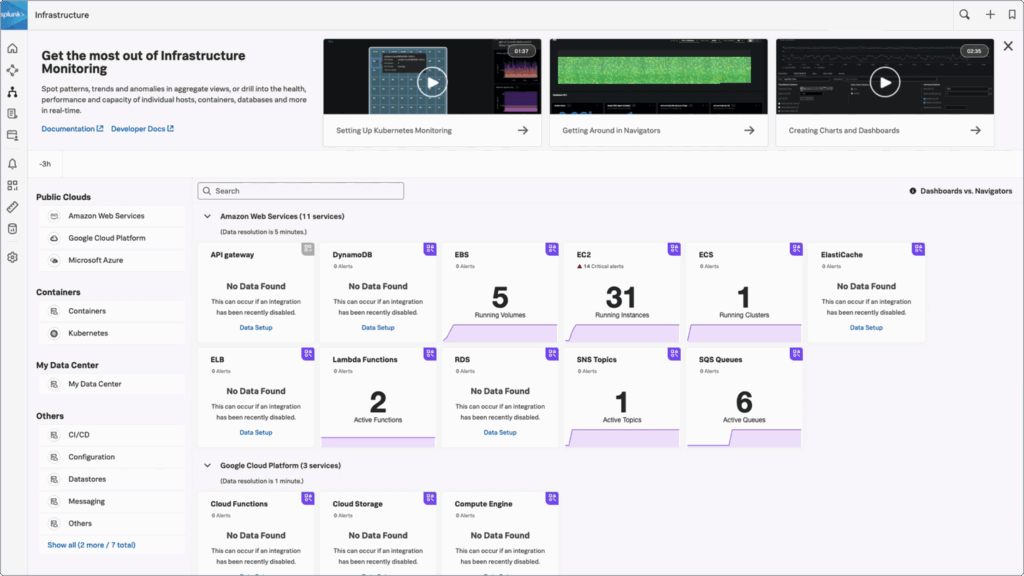
Splunk Infrastructure Monitoring provides real-time visibility into hybrid cloud environments, making it easier to understand how infrastructure behaves across changing and distributed systems. With OpenTelemetry-based data collection, a wide range of service integrations, built-in alerting, live dashboards, and AI-driven analytics, teams can identify issues in seconds instead of manually piecing together signals from different tools. It helps reduce operational effort while improving speed, clarity, and day-to-day monitoring effectiveness.
2. Application Performance Monitoring (APM)
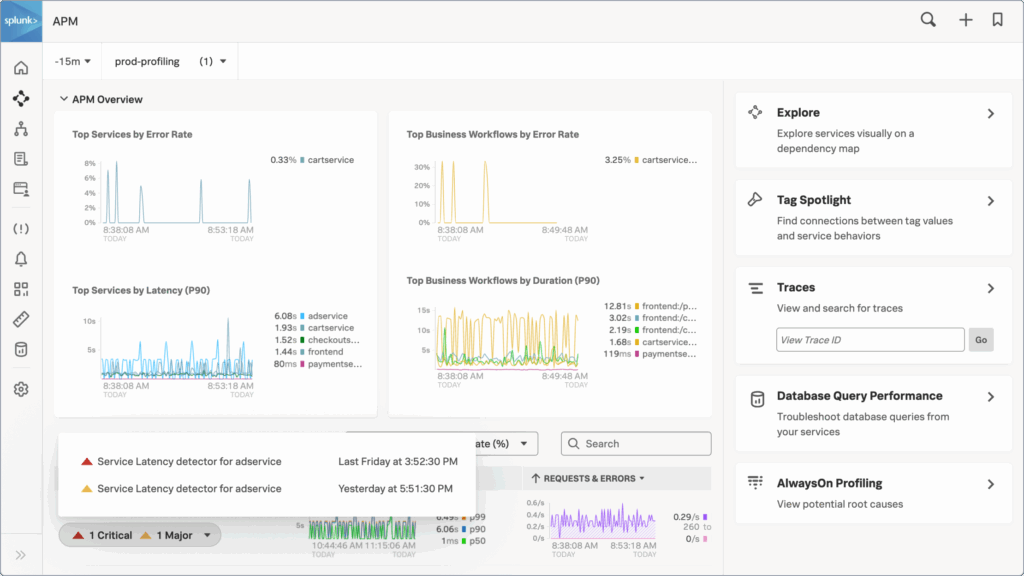
Splunk Application Performance Monitoring helps teams detect, troubleshoot, and optimize performance issues across applications with much more context. By visualizing service dependencies, latency, error rates, and workflow behavior, it gives engineering teams a clearer understanding of how applications perform in real environments. It also supports deep root cause analysis down to detailed log data, making it easier to pinpoint bottlenecks, resource allocation issues, or failing components before they create wider business impact.
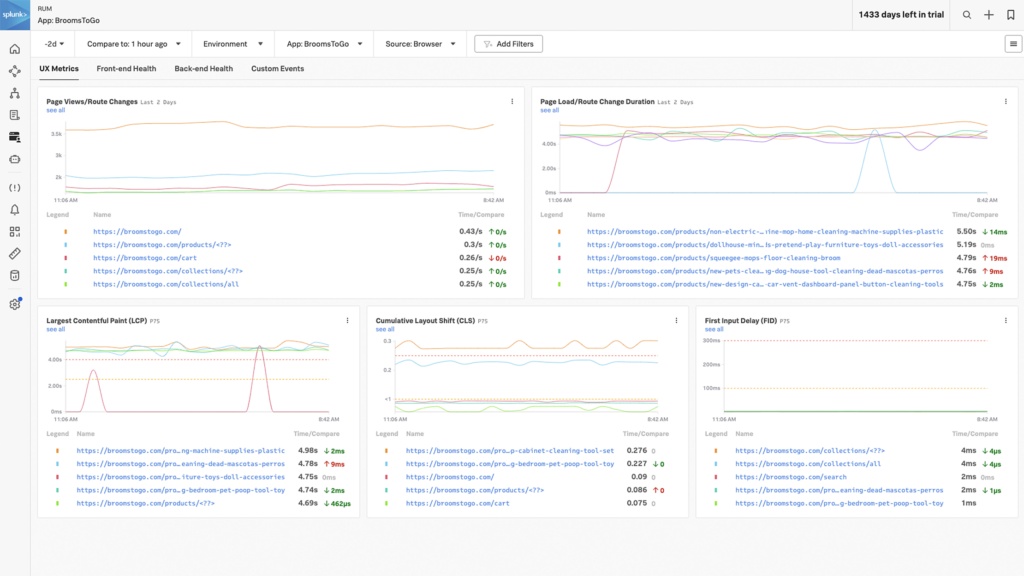
3. Real User Monitoring (RUM)
Splunk Real User Monitoring provides full visibility into real user experience by showing how web and mobile applications perform in actual usage conditions. Instead of relying only on internal performance signals, teams can see how users experience speed, responsiveness, and transaction quality across every session. This makes it easier to identify friction points, reduce mean time to resolution, and improve customer experience based on what users are really seeing rather than what teams assume they are seeing.
4. Synthetic Monitoring
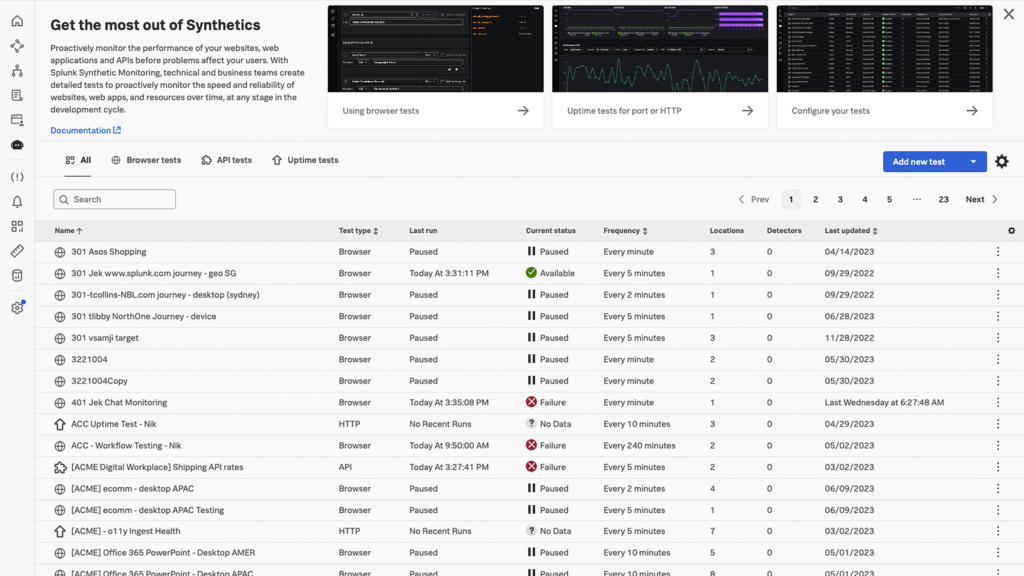
Splunk Synthetic Monitoring allows teams to detect and prevent issues before users are affected by continuously testing critical services, APIs, and transactions. It gives organizations a proactive layer of monitoring that helps validate availability and performance even before real-user impact begins. This is especially valuable for business-critical journeys, where early detection can reduce downtime, protect customer trust, and make it easier to optimize digital performance over time.
5. IT Service Intelligence (ITSI)
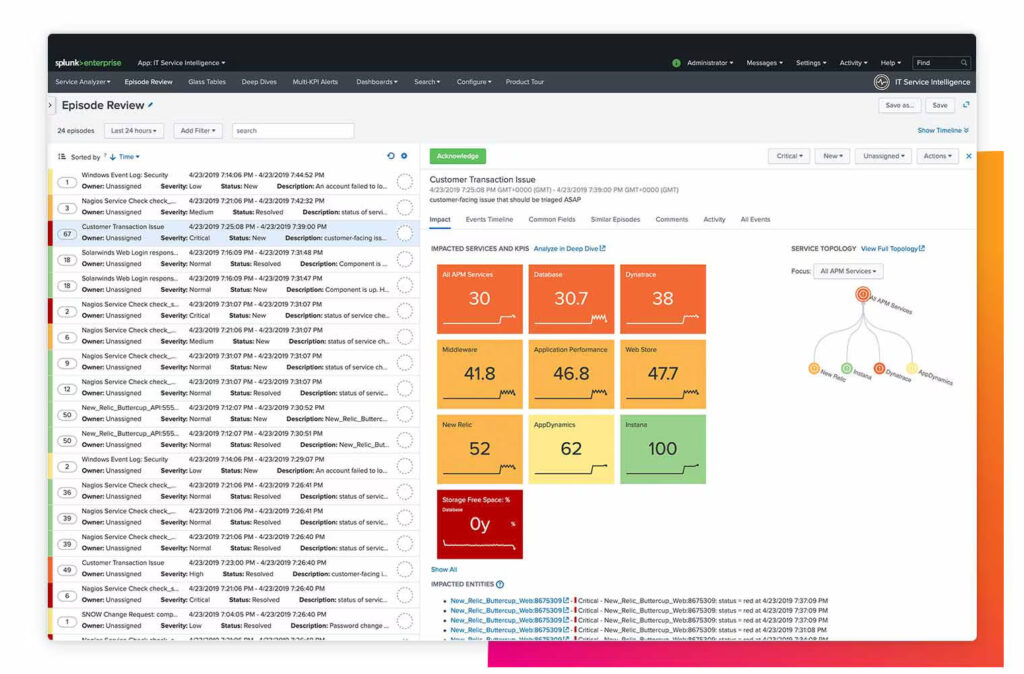
Splunk IT Service Intelligence is an AIOps solution that uses machine learning and predictive analytics to reduce alert noise, improve service visibility, and identify issues before they affect users. By helping teams focus on the signals that actually matter, ITSI supports faster incident response and more informed operational decisions. It also adds stronger business and service-level context, which helps organizations connect technical issues to broader service impact.
6. AppDynamics and Business iQ
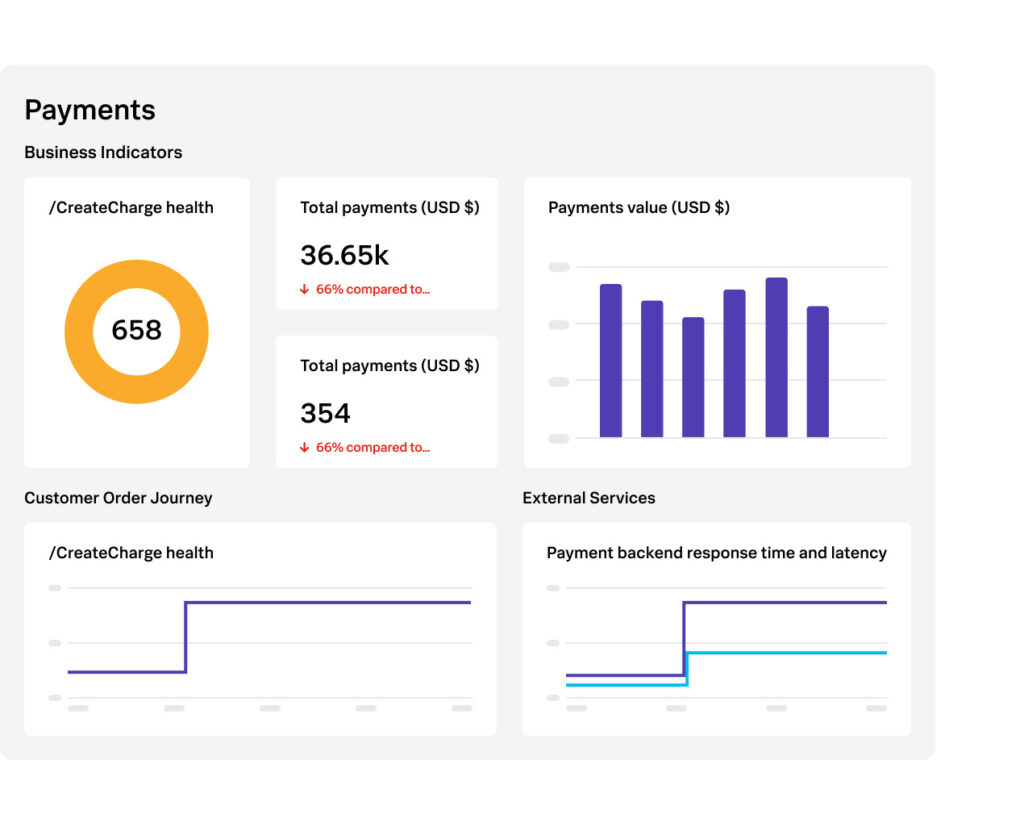
Splunk AppDynamics focuses on full-stack application performance monitoring and infrastructure troubleshooting, helping teams identify and resolve technical issues quickly across complex environments. Business iQ, in contrast, extends that visibility into the business layer by mapping performance data directly to outcomes such as revenue, user experience, abandonment, and conversion rates. Together, they help organizations understand not only what is happening technically, but also what that performance means in business terms.
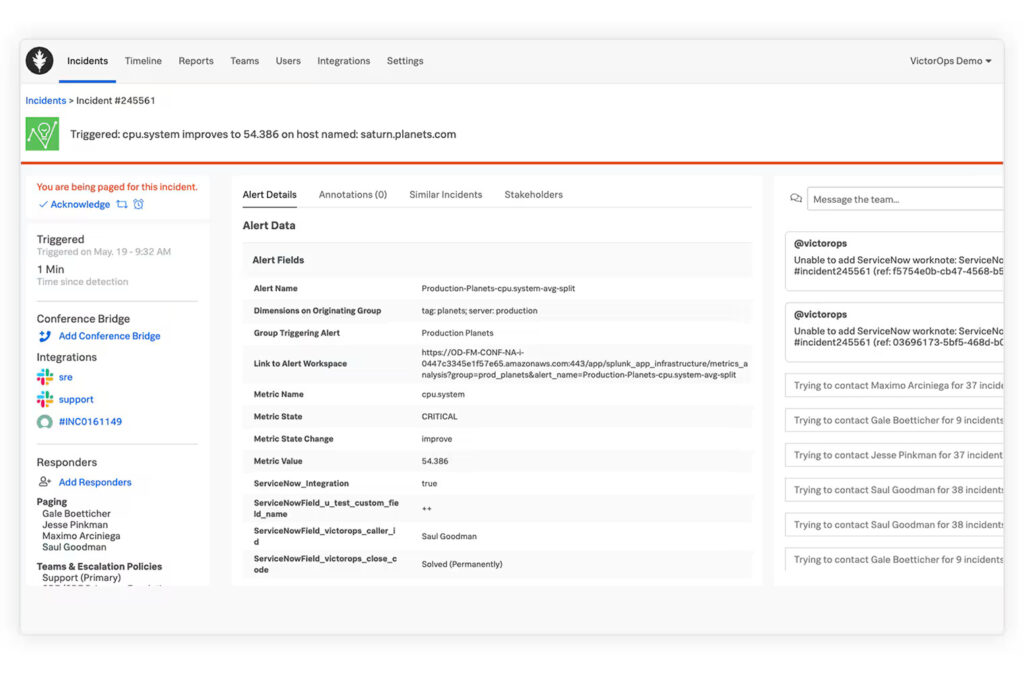
7. Splunk On-Call
Splunk On-Call ensures alerts reach the right people at the right time, helping teams improve incident response speed and collaboration. While monitoring tools generate alerts, On-Call helps route them intelligently so the correct individuals and teams can respond faster and with less confusion. With flexible notification options, escalation policies, and a mobile-first experience, it also improves the on-call experience itself while supporting faster acknowledgment and resolution.
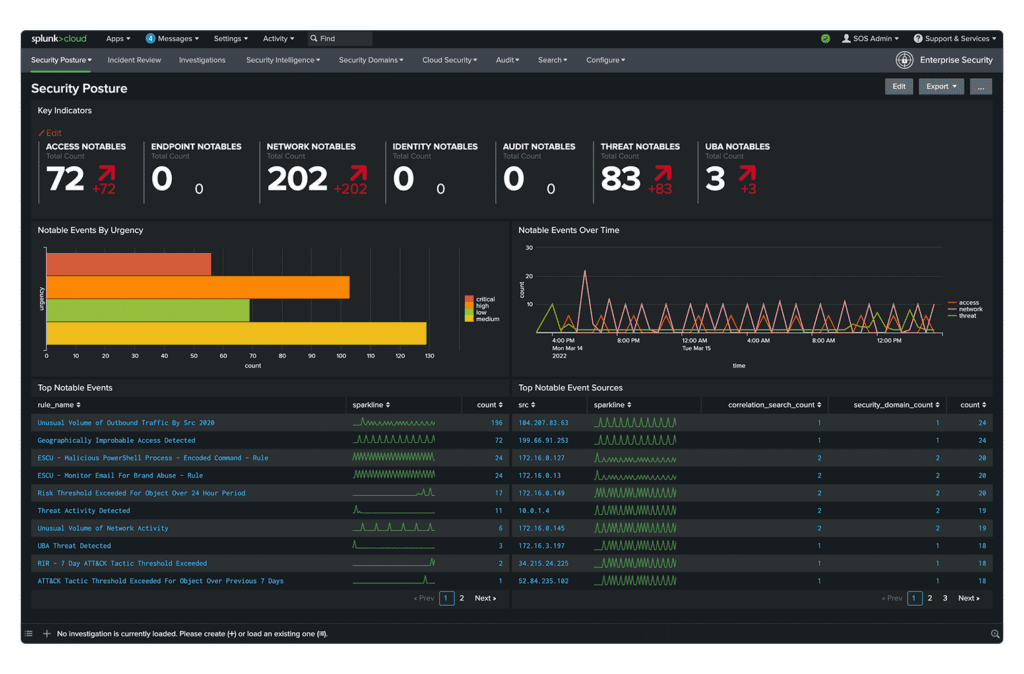
Splunk Enterprise Security
Splunk Enterprise Security is an AI-powered security operations platform that helps organizations detect, investigate, and respond to threats efficiently.
By combining SIEM, SOAR, and machine learning, it reduces alert fatigue and enables faster, more accurate incident response.
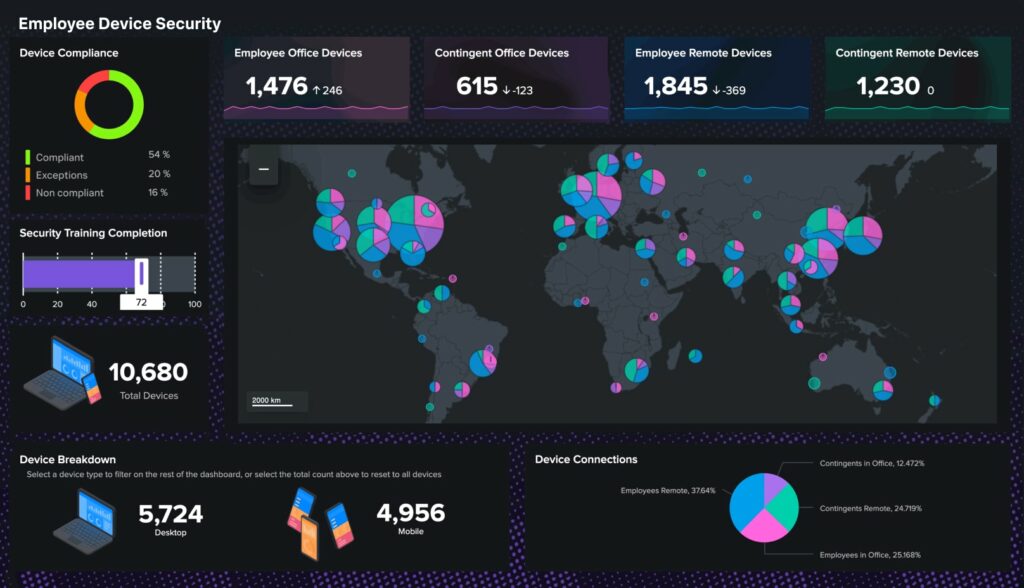
Splunk Platform
Splunk Platform is the foundation that powers the entire ecosystem. It collects and processes machine data from any source, turning logs, metrics, and events into actionable insights.
With AI-powered analytics, federated search, and thousands of integrations, it enables organizations to unify data and build scalable observability and security solutions.
AI in Splunk
Splunk has been using machine learning across its products long before the recent AI surge. As a long-standing leader in observability, it has steadily expanded AI and ML capabilities to help teams detect issues earlier, reduce noise, and make faster decisions.
According to Splunk’s Artificial Intelligence for Observability whitepaper, both Splunk Cloud Platform and Splunk Enterprise include AI capabilities that can identify anomalies, generate forecasts, make predictions, and cluster data into meaningful groups. In practice, this means teams can detect unusual spikes in application errors, forecast resource usage, predict potential outages, and identify patterns such as misconfigured services or abnormal network behavior.
Splunk also brings machine learning directly into several products across its portfolio. These include out-of-the-box ML analytics in Enterprise Security, predefined threat detection models in User Behavior Analytics, adaptive thresholding and outage prediction in IT Service Intelligence, and assistive tools in Infrastructure
Why Businesses Choose Splunk?
Splunk stands out as a core data platform because it combines flexibility, scalability, and operational clarity into one unified system. It is designed to handle modern data complexity while still keeping performance, cost, and usability under control.
One of its biggest strengths is flexible data ingestion. With a schema-on-read approach, Splunk allows organizations to ingest data in any format and apply structure only when needed. This makes it ideal for handling high-volume and constantly changing data without slowing down operations.
Splunk also delivers strong performance through its scalable indexing architecture. Data is automatically organized across storage tiers, helping optimize both speed and cost while ensuring that critical data remains easily accessible.
At the same time, Splunk simplifies operations with centralized data management. Instead of relying on multiple disconnected tools, teams can manage data collection, search, analysis, and visualization from a single platform. This reduces complexity and improves overall efficiency.
Another key advantage is SPL (Search Processing Language), which provides a consistent and powerful way to query data across different sources. Combined with AI-assisted features, it becomes easier for teams to explore data, investigate issues, and extract insights without deep technical overhead.
Splunk also supports OpenTelemetry, enabling vendor-neutral data collection and ensuring organizations can build observability strategies without lock-in. This creates a more flexible and future-proof environment.
Finally, Splunk offers better financial control through predictable cost models, helping organizations manage data usage and avoid unexpected spikes as systems grow.
Together, these capabilities allow organizations to prevent issues earlier, respond faster to disruptions, and adapt more confidently to change, making Splunk a strong foundation for modern observability and data-driven operations.
Real-World Example: Fraud Detection with Splunk
One of our financial client struggled with slow fraud detection, disconnected data, and manual processes. By implementing Splunk, we were able to centralize data, apply risk scoring, and improve real-time analysis. The result was faster detection, reduced operational effort, and stronger risk management.
See Splunk in action
Read the full case study to see how we utilized Splunk to deliver measurable impact.
Read the case studyHow to Get More Value from Splunk
Getting value from Splunk is not only about having the platform in place. It is about making sure the platform is structured, managed, and used in a way that supports real business and operational outcomes over time. Organizations often get the strongest results when they focus on collecting meaningful data instead of indexing everything by default, because the quality and relevance of data have a direct impact on visibility, performance, and cost.
It is equally important to design dashboards, alerts, and search workflows that help teams make decisions quickly instead of creating more noise. As environments expand, architecture should also evolve to support higher data volumes, new use cases, and growing operational complexity. At the same time, strong governance and cost control help ensure that Splunk remains sustainable, efficient, and aligned with business priorities.
Get your Splunk Health Checklist
Download the complete Splunk checklist, prepared by our experts. Simply fill in the form below — we promise not to send you any spam.
Thank you!
You have successfully joined our subscriber list.
Why Work with a Splunk Partner
Splunk is a powerful platform, but like any advanced technology, its real value depends on how well it is implemented, governed, and continuously improved. Working with an experienced Splunk partner helps organizations reduce unnecessary risk, avoid common setup mistakes, and reach value faster without having to solve every challenge internally.
A strong partner brings more than technical delivery. They help shape the right architecture, guide data strategy, improve cost efficiency, and ensure that observability practices support real business needs. This makes it easier to scale Splunk with confidence, improve long-term reliability, and get more out of the investment without building a large specialist team from scratch.
About WeAre Solutions Oy
WeAre Solutions Oy is a Finnish observability-focused consultancy and a leading Splunk Elite Partner in the Nordics. We specialize in observability and monitoring (using Splunk), Atlassian services (Jira), and software development. Founded in 2016 and headquartered in Helsinki, our mission is to turn observability into a competitive advantage for organizations. We work with organizations that need more than just tooling. They need a partner who understands how to connect technical visibility with business value.
Our experience includes supporting regulated and business-critical environments, where reliability, clarity, and long-term maintainability matter. We combine consulting, implementation, optimization, and managed services into one seamless model, helping our customers move from fragmented visibility to stronger operational control with confidence.
At WeAre, we help organizations assess their Splunk environments, identify improvement opportunities, and align performance with real business needs. You can start with an observability assessment to understand your current state, or contact our team for a free consultation.
Free Observability
Assessment and Consultation
30-minute expert consultation
Custom improvement roadmap
Detailed assessment report
Disclaimer: All dashboard visuals in this blog are sourced from Splunk product materials.
Facebook
Twitter
LinkedIn